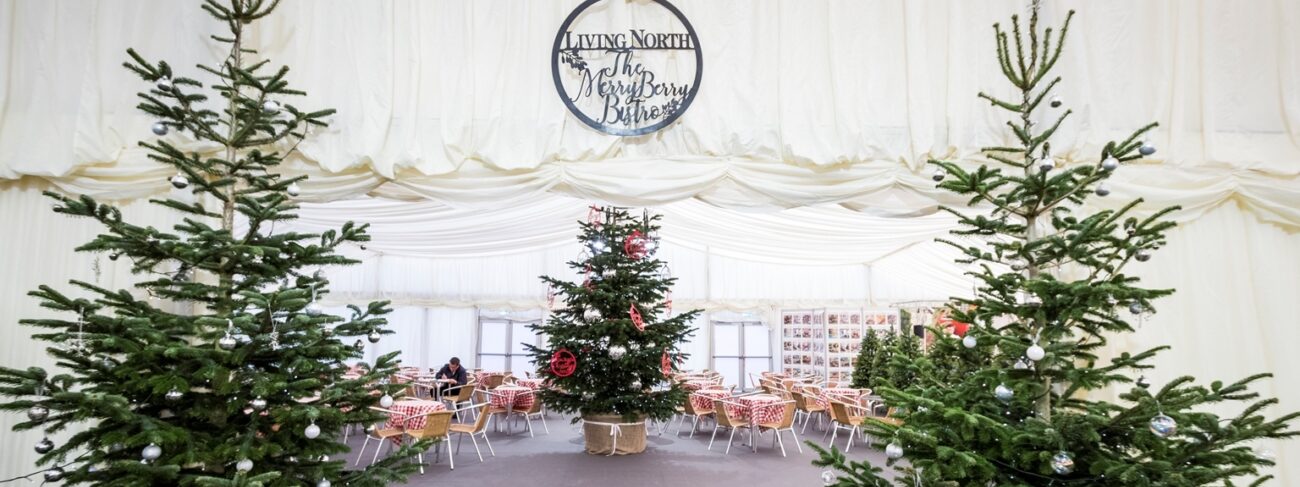
If you’re hiring a marquee for a winter event, getting the heating right is a real priority. After all, comfortable guests will linger longer, spend more, spread the word and come back again next year. So, what kind of marquee heating options are there? And how do you work out what’s right for you? Our marquee heating guide has got you covered…
Turning your marquee into a warm, inviting event space in winter might seem like a challenge, but it’s all about the experts you bring in. Here at GL events, we collaborate with our sister company Flow Power to make it happen for all sorts of clients, in all sorts of weather. For this marquee heating guide, we sat down with their Commercial Director Graham Dames to explore the options and discuss what you can do to reduce the impact of rising fuel costs ahead of your winter event.
Is there an ideal target temperature for a winter marquee?
It all depends on your event, your guest numbers, your budget and the kind of marquee you’re hiring. If you’re holding a Christmas market, people will be coming in and out and expect to keep their coats on, whereas if you’re holding a Christmas party or corporate celebration, they’ll be sitting for periods of time and wearing fewer layers, so the marquee heaters you need will be different.
At Flow, we’ll collaborate to make sure we reach the desired temperature. This includes assessing the internal temperature needs and other heat loads that might involve production, coupled with the expected external ambient temperatures and your budget, the ideal solution can be discussed. The target temperature is really driven by how your guests will use the marquee. For example, if you are organising a Christmas market, where people will be entering and exiting frequently without dwelling inside, a temperature range of sixteen to eighteen degrees is generally a comfortable temperature to aim for. If guests will be stopping inside the structure, taking coats off and lingering, for example, a temporary Christmas party venue, or a bar space to complement an ice rink, twenty to twenty-two degrees is an optimal range.
This of course can be adjusted and specified to achieve different temperature targets irrespective of ambient temperatures.
Alternatively, if you’re working to a tight budget, you can approach your marquee heating from that standpoint, giving your heating supplier a figure to work with and asking them to recommend the best achievable option for your budget.
Make your winter event sparkle
Does your event need a festive glow up? Find out how our seasonal winter event infrastructure will transform your event.
How can I make sure I reach and maintain that temperature?
The most accurate way of monitoring the temperature inside your marquee is with internal thermostats, set across the structure. These also give you the added benefit of being able to control the temperature too, holding it at a nice warm level while your guests are inside, and allowing it to drop to a specified level during downtime or overnight.
In the winter, setting a thermostat at just above freezing overnight is a great way to protect against frost or snow load on roof panels, keeping your marquee in the best possible condition. If an internal thermostat is used, this can be fully automated to make sure your marquee maintains the desired temperature.
How well insulated are marquees?
Whether you’re bringing in winter heating, summer cooling or even a combination of both, your power supplier should take into account the type of material your marquee is made from, and its insulating properties.
These are called U values, the rate of heat transfer through a structure component. They represent the likely level of heat loss through any given material, and they’re a key part of calculating what marquee heating you’ll need.
The lower the U value, indicated better thermal performance, and in turn the less heat you’ll need to generate, the less energy you’ll use and the less you’ll pay. So in winter, your marquee supplier should be specifying as low a U value as possible.
In reality, most standard marquees have a relatively high U value, whether they have soft sides or rigid panels. But the right insulation makes a big difference. At GL, we can offer thermal linings to keep winter events warmer and summer events cooler. Added to walls and ceilings, they create an insulation layer that helps maintain your ideal temperature and reduce the extra heating or cooling you need.
“Whether you’re heating or cooling, the better the thermal quality of your marquee, the fewer kilowatts you’ll need, and the less you’ll pay.”
Graham Dames
Commercial Director, Flow Power Solutions
What power source can I use for marquee heating?
Right from the earliest stages, it’s important to understand how you’re going to power your event, from the heating and lighting to any other equipment you might need. Integrating that into your plans from the start will help you be as energy efficient and cost effective as possible.
Whether you’re in a city centre or somewhere much more remote, find out from the venue, council or landowner whether there’s a power source on site, and what kind of power that is. If mains electricity is available, it’s always the best way to go, reducing the cost of equipment and fuel.
If it’s not obvious whether there’s mains power on site (and it often isn’t), ask your heating supplier to help. A site survey can often give you a clearer picture of what’s possible, and experienced suppliers will have a better idea of how to tackle the problem.
What’s the best marquee heating system?
Marquees come in a whole range of sizes, shapes and specifications, so when it comes to how to heat a marquee, one size doesn’t fit all. The right option for your event will be dictated by the space you’re trying to heat, the internal configuration and the budget you’re working with.
It’s also very common to use a series of different heating options to heat different parts of your marquee, especially if you’ve got a mixture of large, open spaces and smaller break-out areas.
If you’re not sure what size marquee you’ll need, our online marquee configurator tool can give you a clearer picture in just a few clicks, helping you understand your heating needs better.
How should I heat a smaller marquee structure?
If you’re heating a smaller structure or space, like one of our pagodas or gazebos, a simple 18-kilowatt fan heater can warm it up quickly and effectively and can very often be plugged into the venue’s mains supply. If your event’s going to have a whole series of pagodas, it’s an approach you can duplicate simply and flexibly, without needing more complex infrastructure.
Do medium-sized marquees need more robust heating?
Medium-sized marquees will typically need a higher heat load, such solutions can be satisfied by boilers or heat pump chillers coupled with internal heaters to deliver the increased heating capacity. Where structures are partitioned, smaller direct or infrared heaters may provide part of the overall heating solution. We always look to optimise efficiency of performance by assessing power needs. In most cases infrared heaters can still just be plugged into a mains supply, making your event infrastructure quicker and easier to set up.
Infrared heaters create a radiant surface heat that you’ll feel if you’re near them, rather than blowing air out into the space like a fan heater. It’s important they’re safely installed away from marquee linings, but they can be an effective way to help heat a medium-sized marquee.
What’s the best way to heat a large marquee?
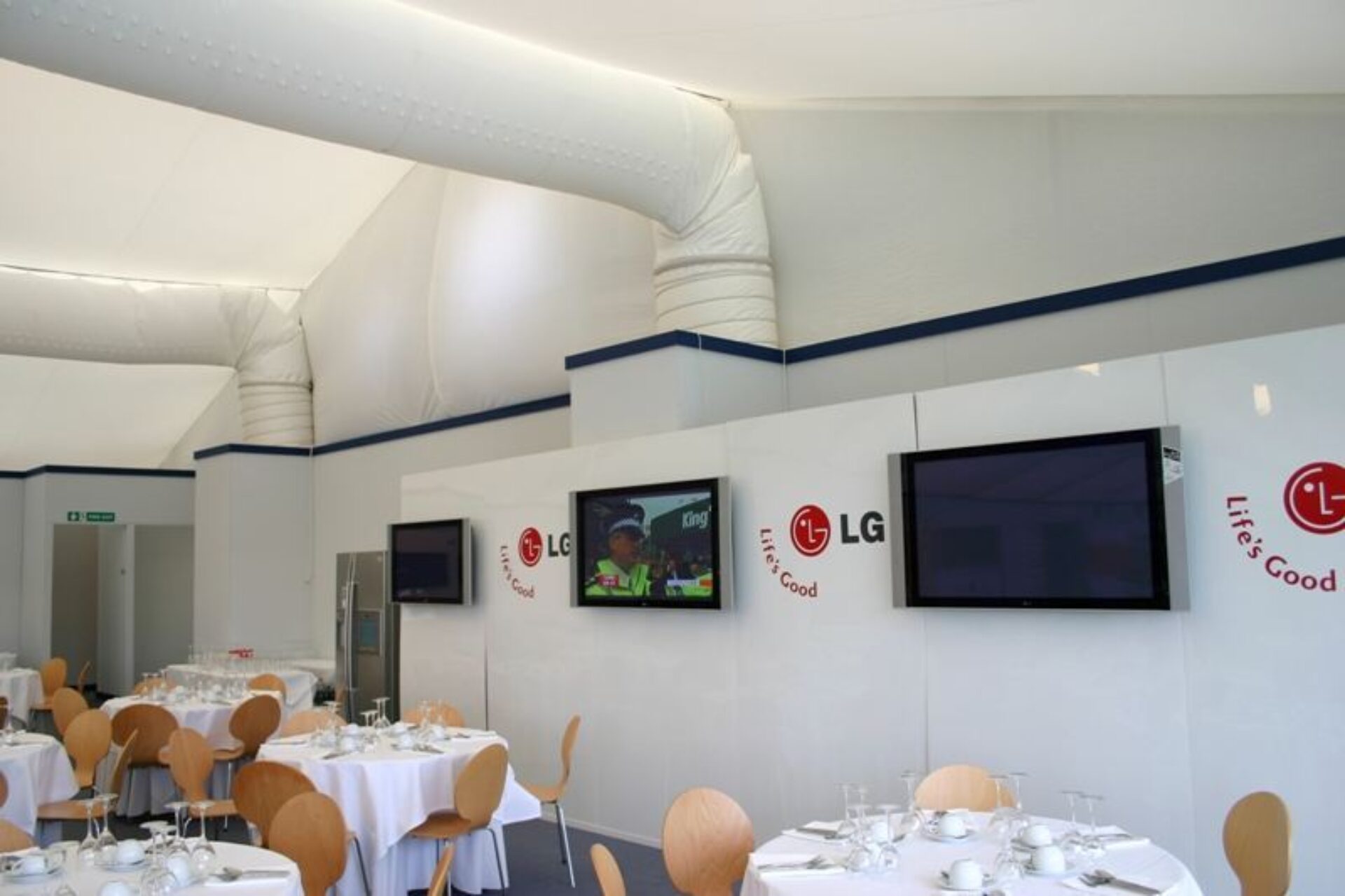
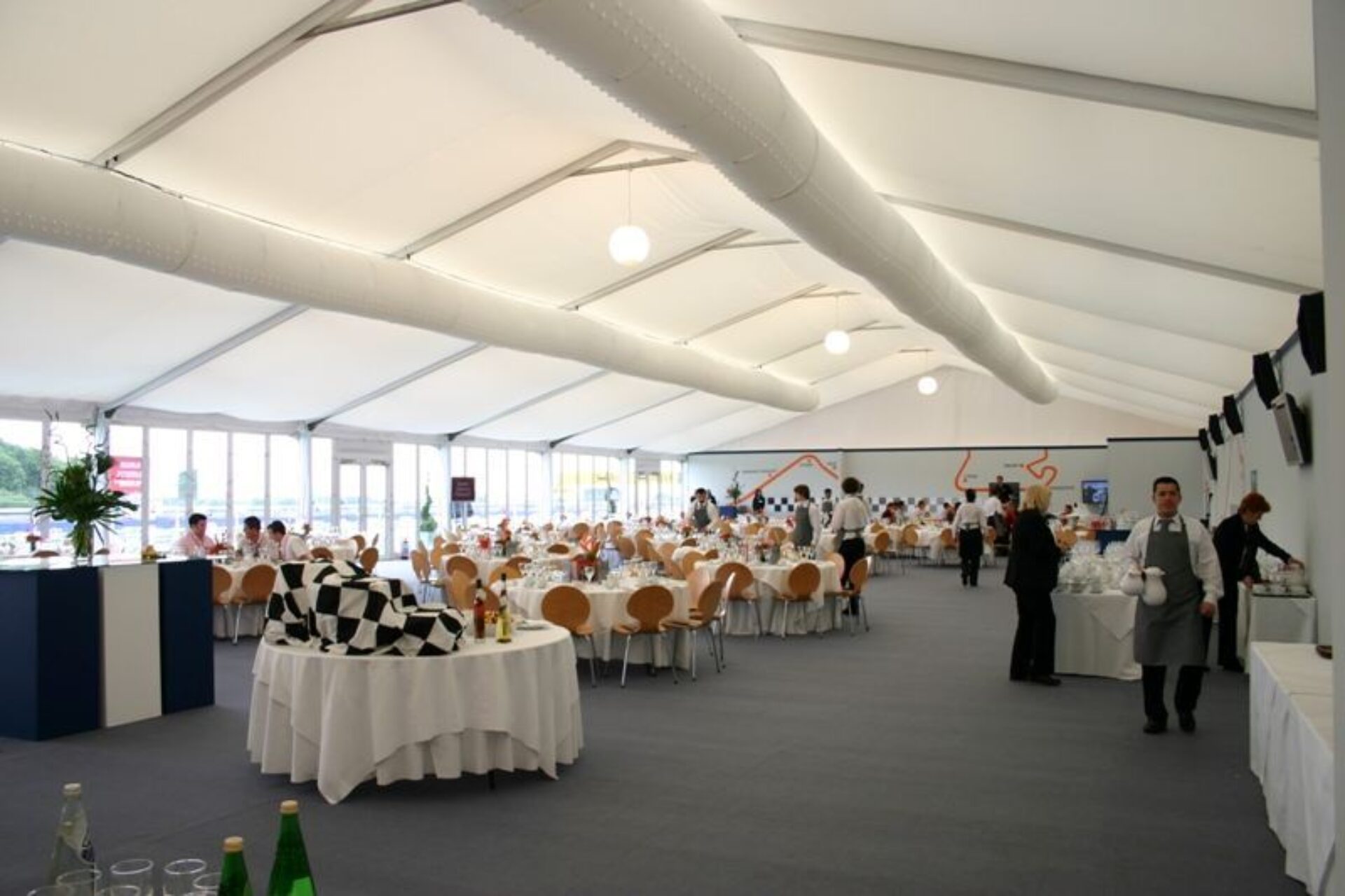
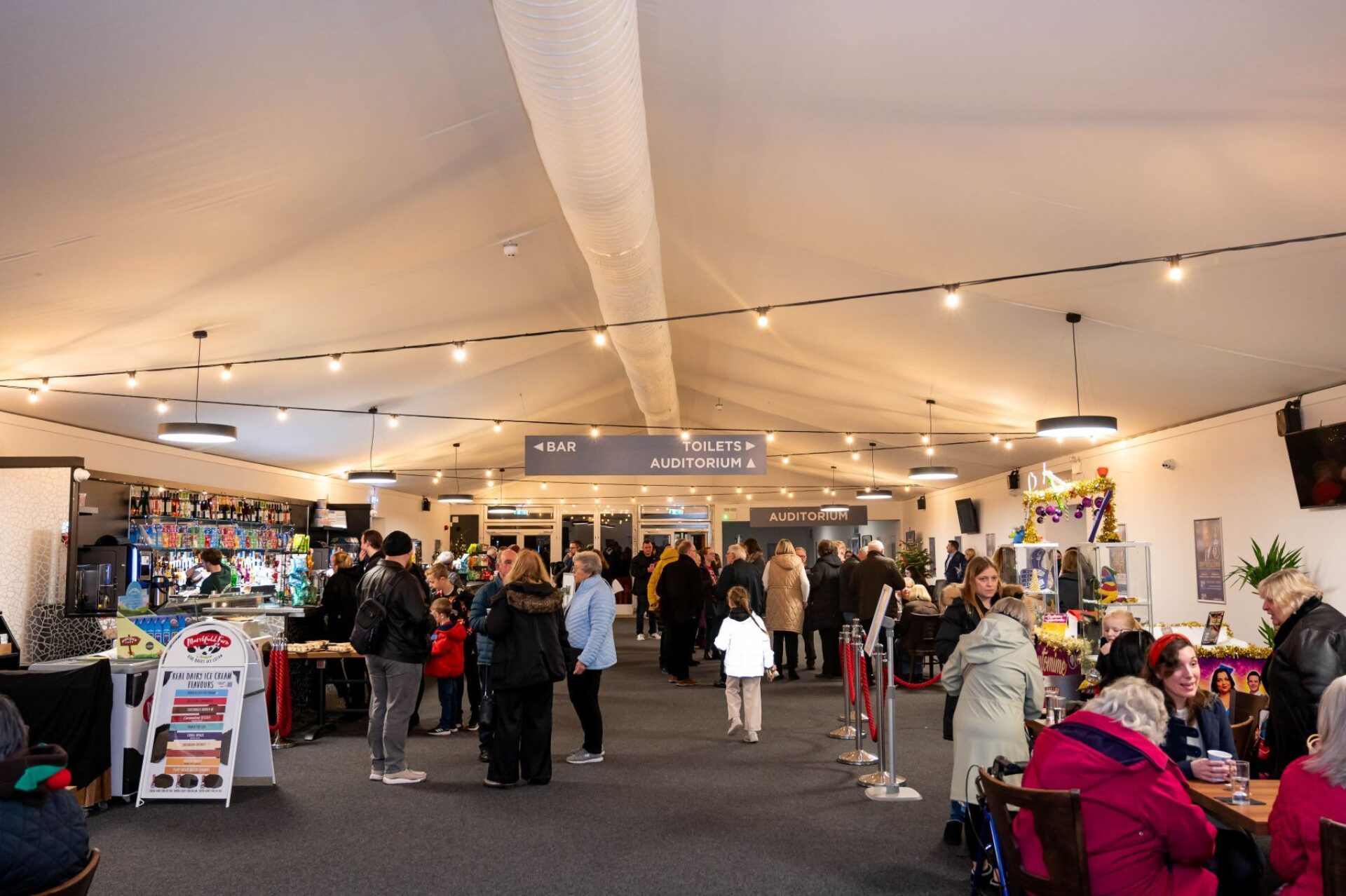
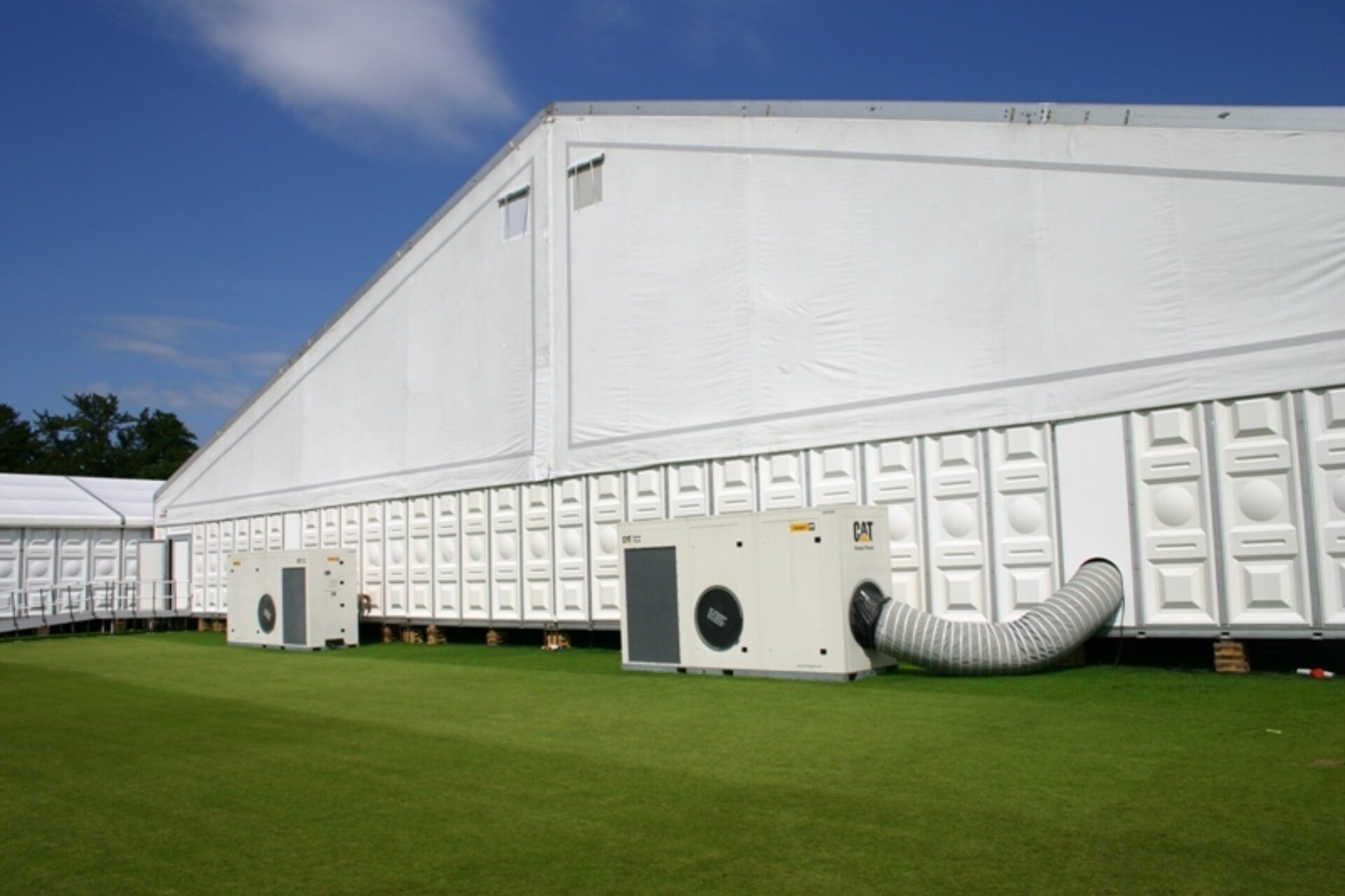
When you’re heating a large marquee with a big, open internal space, we usually recommend an overhead ducting system as your main heat source. They’re built into the ceiling of your marquee, terminating at an external wall – and because we work closely with our power team from an early stage, we can sensitively design them in, without impacting your event’s aesthetic.
Overhead ducting systems usually have one of two heat sources – indirect diesel-fired heating (IDF) or a hot water boiler. It is worth checking with your heating supplier to determine if their IDF heaters can use alternative, more sustainable fuels such as HVO. Flow’s IDF heaters are HVO ready. Both options sit outside your marquee, blowing heat into the ducting, with air handlers pushing it around the system to heat the entire space. The difference between them? IDF heating needs a lot less electricity but instead demands more source fuel to generate heat. While these larger-scale systems are ideal for your main event space, you might also decide to incorporate other options like fan or infrared heaters for smaller, break-out rooms and spaces.
What are reversible marquee heating systems?
Reversible systems – often called split DX or heat pump systems – can be used both to heat your marquee and to cool it down. They’re useful in the spring and autumn, when temperatures can still be very low in the mornings and evenings, but it’s relatively warm in the middle of the day. Combined with internal thermostats, they can help to keep your marquee temperature steady and comfortable around the clock, especially beneficial for spring or autumn events.
Do you want more expert insight like this?
Subscribe to our monthly newsletter and join over 8,000 event professionals to get the latest insight straight to your inbox.
What are air curtains?
Air curtains are electric heaters fitted above the doorway of your marquee, blowing warm air down onto your guests as they come in. You’ve probably experienced them when you walk into shops or other venues, especially during the colder months.
While you’d still use other heat sources to keep people warm once they’re inside your marquee, air curtains create an inviting feel as they arrive. They also create a barrier that reduces the amount of heat escaping from the rest of the structure.
What is spot heating?
Spot heating is all about providing localised heat within a marquee, often by using fan or infrared heaters to warm the people close to them, rather than heating large open areas. It’s often used in isolation, like with the small marquees or break-out spaces we mentioned earlier, but it can also be used to complement larger-scale systems by adding targeted warmth where it’s needed. For example, if you have members of staff positioned at a fixed location, such as a ticket check point within the marquee, a spot heater will provide direct heat to the area, keeping your staff comfortable.
How long does it take to heat a large marquee?
If you’ve got the right heating in place, designed for your specific marquee size, specification and U value, you should notice a significant change in temperature within an hour of your marquee heating system being switched on.
Do I need ventilation as well as marquee heating?
It’s up to you. If you’ve got a lot of people inside your marquee for a long time, and your heating or cooling system is just recycling air rather than bringing it in from outside, then that air can start to feel stagnant and can produce condensation. Ventilation in these instances should be considered.
If your budget’s tight, that might be something you can live with to prioritise other things. But if you want to create the best possible guest experience, ventilation is a great addition, drawing fresh air in to create a more comfortable environment.
To create that ventilation, we look at the total volume of the internal space, the equipment you’re using for heating or cooling and the volume of that equipment’s air handlers. By specifying products that are slightly over capacity from an air moving perspective, we’re able to achieve the air changes you need to keep the space inside feeling fresh.
Working to a tight event budget?
Maximize your event budget by value engineering your marquee with the experts. Find out how you can save costs in our value engineering guide.
What can I do to counter rising fuel costs?
Global events are having a major impact on fuel prices, creating an increasingly volatile market, and we may still feel the effects of this as we head into winter. With that in mind, many event organisers are looking to reduce the amount of fuel their events need. But how?
If you have access to electrical mains power, it should always be your preferred option, rather than bringing in temporary power generation. If you do need to bring in temporary power generators, they often have quite high burn loads, but experienced teams like Flow Power can look at ways for you to burn less.
The load-on-demand approach can be especially helpful for this. For instance, rather than using one large generator, your supplier might recommend splitting your power requirement across multiple generators, so they can cycle on and off. When your power needs dip in certain areas, those machines go off, and fuel burn is reduced. And when you need them again, they cycle back on.
Alternatively, if your event needs a lot of power in the day and very little overnight (for example, you just need to keep a few fridges running), that’s a good opportunity to use a battery and save on fuel. So as your power needs go down, your generator would turn off, and you’d just rely on the battery, meaning your only fuel burn would be the small amount required to recharge it.
How can I heat my marquee more sustainably?
Hydrotreated vegetable oil (HVO) is a clean, sustainable diesel alternative that can reduce emissions by up to 90%. Even better, it’s a straight swap for diesel and can be used in the same machines without the need for any adaptations.
Until recently, the price of HVO was a real barrier, at 30 to 40p more per litre than diesel. But with recent price shocks, that gap is closing and it’s becoming a good time to try a greener fuel, without paying much more. The only caveat? As demand for HVO increases, the price could too. Which brings us back to the basic principle – it’s always better to burn less.
It’s also becoming easier to power parts of your event by adding solar panels or wind turbines to your temporary infrastructure. Yes, solar panels won’t generate as much power in winter as they would in summer, but they’ll still give you some benefit – and wind turbines will have the great British weather firmly on their side.
Find out how we are improving event sustainability
Year on year, we strive to further reduce our carbon footprint and look for additional ways to operate more effectively, efficiently and sustainably.
How can I start working out what I need?
Having the right data behind you is hugely helpful when you’re establishing the most energy and cost-efficient marquee heating system for your event.
If you’ve got clear data on the space you’re heating, the marquee’s insulating properties and the temperature you want to achieve, you can right-size your heating equipment. In turn, that means you can often reduce the size of your generator and the amount of fuel you need. That’s where really experienced marquee, power and heating teams can make all the difference to your plans.
“It’s about experience, partnership and knowing the numbers. That’s what a trusted power and HVAC supplier can bring, and it honestly changes everything.”
Graham Dames
Commercial Director, Flow Power Solutions
Like to talk about your next winter event?
At GL events UK we’re part of a global group with a 5,000-strong team, delivering complex events, all over the world. Here in the UK, we host more than 150 events every year. So, whatever you’re planning next, we’re always happy to talk it through. Just get in touch.
Recent articles