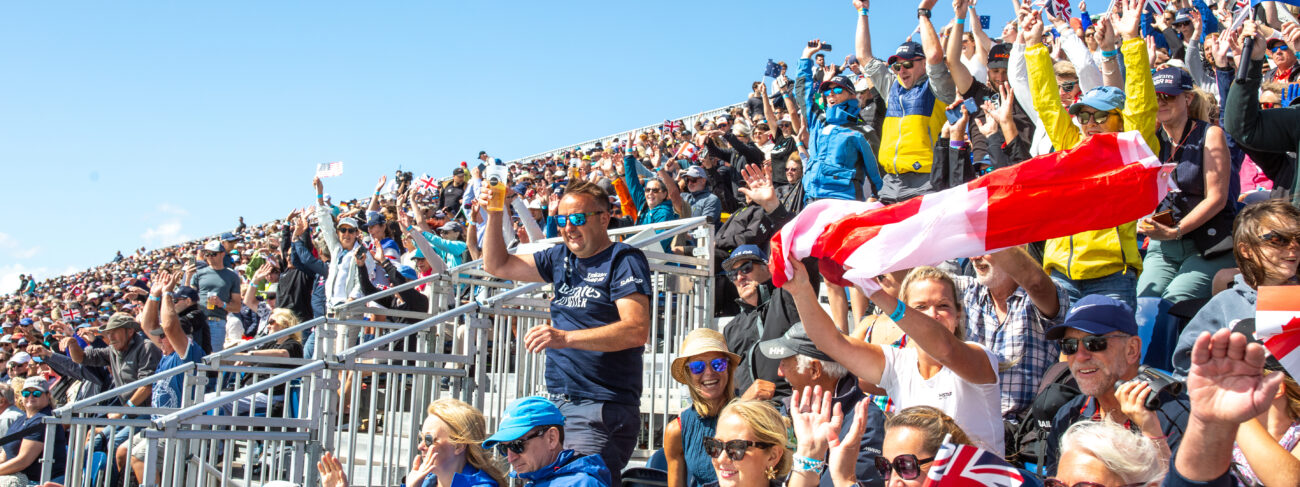
Successful events on any scale are all about balance. On the one hand there’s your big, bold vision. On the other… there’s your budget. And whether that budget’s looking generous or a little smaller than you’d like.
Getting the absolute most from that budget is what makes an event memorable, profitable and repeatable. So, if you’re hiring grandstand seating, how can you make your event budget work harder? When grandstand seating’s part of your plans, it’s usually a significant part of your spend. And rightly so. Grandstands are complex structures and carefully designed, rigorously safety-tested seating is a pivotal part of the guest experience that’s always worth investing in.
But that doesn’t mean costs are immovable. Going thorough a collaborative value engineering process with your grandstand seating supplier can open up opportunities to adapt plans and designs. This can create savings or show you where extra budget will make maximum impact.
We’ve taken a deep dive into value engineering for events in our guide How to make your event budget go further. But here, we’re zeroing in on how to apply the value engineering process to grandstands, sharing our step-by-step approach and key areas to consider.
Value engineering, step by step
At GL, we work on a huge range of complex, high-profile events every year, from the Commonwealth Games and The R&A Open to the Hay Festival and The Secret Cinema. We’ve used all of that experience to develop a three-step framework for value engineering that gives our customers clarity, control over their budgets and creative new approaches to their event challenges.
We’re sharing it in this guide because it’s a simple, powerful approach you can use for all sorts of events, large or small. Here we’ve shown how it can apply to grandstand seating:
Step 1: The have-to-haves
Your have-to-haves are, as the name suggests, the real non-negotiables for any grandstand. They’re the minimum requirements you’ll need for a safe, functional event, including:
- A structurally safe, compliant grandstand
- Enough seating capacity for your guests
- Health and safety requirements, including safe access
If you’re planning an evening event or have audio-visual requirements you will also need to add power and lighting to your list of minimum requirements. If you’ve got these fundamental things covered, your grandstand can go up and your event can technically happen. Think of them as a foundation you can build on, adding extra elements (as your budget allows) to enhance your guests’ comfort and experience.
Step 2: The nice-to-haves
Here we’re starting to add details that make your event grandstand more of a comfortable, aesthetically pleasing place for your guests. These include:
- Bigger seats with more legroom
- Better sight lines (more on this in a moment)
- Better egress design
- Upgraded lighting
Step 3: The game changers
Finally, these are the extra touches that can make grandstands feel really special. They often get ruled out right at the start, but with careful value engineering, you might be surprised what you can do for your event budget:
- Shapes and detail that add to the overall statement of the grandstand
- Next-level lighting and illumination
- Padded seating for extra comfort
- Fully branded seating and wayfinding

A three-tier approach
We work on all kinds of huge, complex events at GL, from the Commonwealth Games and Hay Festival to graduations and trade shows. Over the years we’ve developed a three-tier framework for value engineering that gives our customers clarity, control and – very often – creative new ideas. It’s a step-by-step approach you can apply to any event, of any size.
Here’s how it works:
Step 1: The have-to-haves
These are the non-negotiables. The absolute minimum requirements for delivering a safe, functional event. They include:
- A structurally safe, compliant environment
- Basic capacity for your expected guests
- Essential facilities like power, lighting and access
- Health and safety requirements
As long as you’ve got these in place, your event can technically happen. From there, it’s a question of how much your budget will allow you to enhance your guests’ comfort (being warm and dry, with nice toilets and good catering) and their experience (having fun and being able to post something eye-catching on social media).
Step 2: The nice-to-haves
These are where you can start to elevate things. They’re about turning your temporary event structure into somewhere people actually want to be, and include:
- Higher quality flooring
- Improved furniture
- Better climate control
- Upgraded lighting
- Branding and signage
Step 3: The game changers
These are the extra touches that create genuinely memorable experiences. They often get counted out early on, but with careful value engineering, it’s surprising what you can bring in:
- Premium event structures, including multi-deck options
- High-end fit-out, interiors and theming
- Statement lighting and illumination
- Sophisticated branding and wayfinding

Key areas that influence your event costs
Our three steps are a simple way to start making decisions about your event, your budget and your grandstand, giving you clarity around what’s essential and what will elevate the day.
Over the years, we’ve come up with all sorts of ways to deliver grandstands for clients’ budgets, without losing the look and feel they want to achieve. And in our experience, there are a handful of key areas where value engineering can make the biggest difference to your budget.
Let’s take a look…
Rises and sight lines
Fundamentally, the taller your grandstand is, the more it’s going to cost. It’s not just about the number of seats you’ve got (after all, more seats often mean more ticket revenue). Taller rises mean steeper rakes which in turn means increased cost. The bigger the rise, the better the sight line – which means there’s less chance of somebody’s view being blocked by the person in front. That’s great for guest experience, but it also increases labour and transport costs, because your grandstand supplier will need more scaffolding and equipment, and in turn more trucks to transport it.
Value engineering the rake of your grandstand will be about finding the right balance between an acceptable sight line and an acceptable cost. And in a lot of cases, that very much depends on the event you’re planning. For example, we use a bigger rake when we create grandstands for events with a near focal point such as The Open – effectively this is when the crowd is close to the action and it necessitates a taller rise.
You might hear people mention C Values when they’re talking about sight lines. C Values are an industry benchmark worked out using a formula in the Green Guide – a publication that sets out best practice for the development of stadiums. The formula takes into account the height of an average person, the viewer’s focal point, the height and rake of the grandstand and the distance from the focal point, creating different C Values for different types of sports events.
You don’t need to come to us with your event’s ideal C Value, we can work it out and factor it in to both our grandstand designs and the value engineering process. While sight lines vary in different parts of a grandstand, a good supplier will be able to tell you what kind of sight lines you can expect in different areas – and where there might be scope for smaller rises and cost savings.
Something that won’t affect the cost, is the space between the rows – we call this “useful seat depth” and GL events offers a standard depth of 800mm in compliance with The Green Guide. Not all seating providers meet this standard, so it is something to bear in mind when you are shopping around.
Another thing to consider is whether the sight lines allow for the grandstand’s first row to be at ground level, which can reduce the need for understructure and staircases for entry and exit – all of which reduces the equipment needed as well as the logistics and build costs.
Location
One of the biggest factors influencing the cost of a grandstand is its location, and there are two parts to that. First, its location in relation to your grandstand supplier. The further a supplier has to travel, and the more tricky a site is to access, the more that’s going to cost.
But what might be less obvious is the impact of where you want your grandstand to sit within your chosen site. The topography of the site, the condition of the ground and the exposure to high winds can make a huge difference to the kind of supporting structure your grandstand needs – and the more complex that is, the more costs will rise.
We’ll always start with your ideal location, carrying out ground-bearing tests, looking at the data they reveal and working out what it’s going to take to erect a grandstand there safely.
For example, on a recent project, we advised a client that the ground in their preferred position was very soft, which meant we’d need to excavate substantially – essentially digging foundations for the event grandstand to be stable. That’s a big job in itself, and it also triggers a whole lot of restorative work after the grandstand comes down, both of which increase costs.
Our advice was, if you really want us to build it in that location, we absolutely can, but these are the implications from a cost and viability perspective. Alternatively, if you move it to this position where the conditions and topography are much easier, that’s going to free you up to do X, Y and Z interesting things, while actually saving you money.
Of course, for some events, the location is the location and the grandstand can’t be moved, which is what happened when we worked on the famous Postage Stamp at The Open. The client wanted something special and it’s an iconic part of the Troon course, so we really pushed the envelope. They decided the cost was worth it for the guest experience – and it became the best attended grandstand they’ve had for years.
Collaboration
Value engineering works best when it’s a genuinely open, honest, collaborative process, where you and your supplier bring ideas and an open mind to the table. Be open about your budget and what it needs to include, so your supplier knows what they have to work with, and can put all of their experience, network and product knowledge to the very best use.
Some of our clients come to us with big, elaborate dreams for their event or quite off-the-wall ideas – and we love that creativity. What value engineering does is open up the conversation so we can all explore together what realising those dreams might look like and cost, and which alternatives could be just as good or even better, both financially and in terms of wow factor.

Would you like us to make your seating budget go further?
At GL events, we’re proud to be part of a global group with a 5,000-strong team, bringing complex events to life, all over the world. Here in the UK, we host more than 150 events every year, and we’re always happy to discuss yours. Just get in touch with our team.
Want to learn more about grandstand and tiered seating? Explore our full guide.
Improve your spectator seating with GL events
Get the best view by speaking to our team or reading the complete grandstand seating guide.
Recent articles